AVRC Laboratory · 03 · Sense, manipulate, interact
Robotics
Study robot geometry, manipulation, vision, and human interaction with arms and a haptic interface.
Questions to investigate
Trajectory generation and visual manipulation
Haptic interaction and planned teleoperation
Explore each platform
Open a guide for component explanations, an annotated equipment figure, learning activities, and official technical resources.
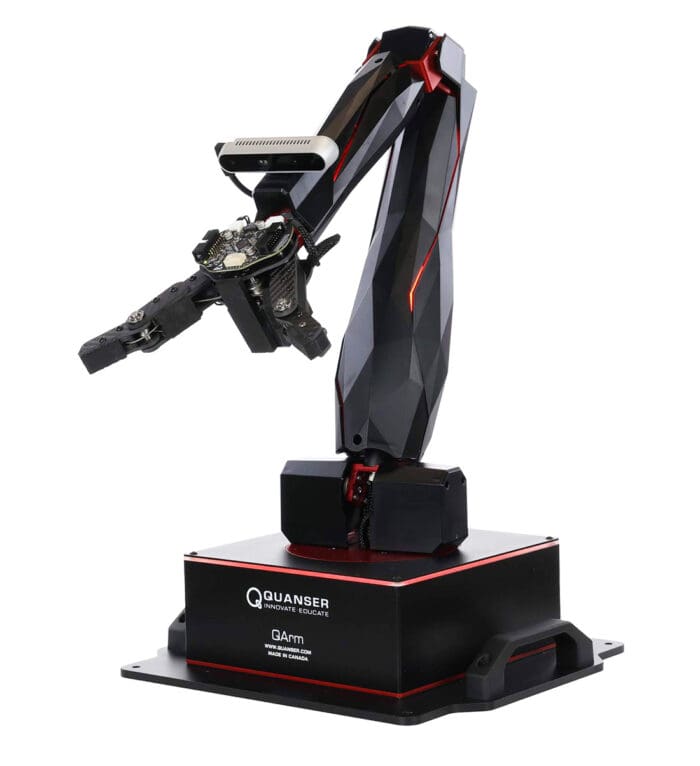 Four arm joints · gripper · RGB-D
QArm →
Connect robot geometry, sensing, and manipulation.
Photograph: Quanser
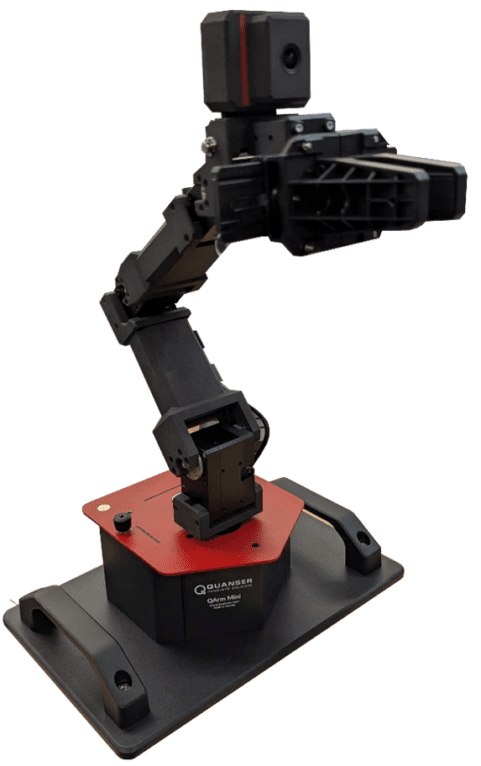 Four arm joints · parallel gripper
QArm Mini →
A compact arm for visual manipulation and mobile robotics.
Photograph: Quanser
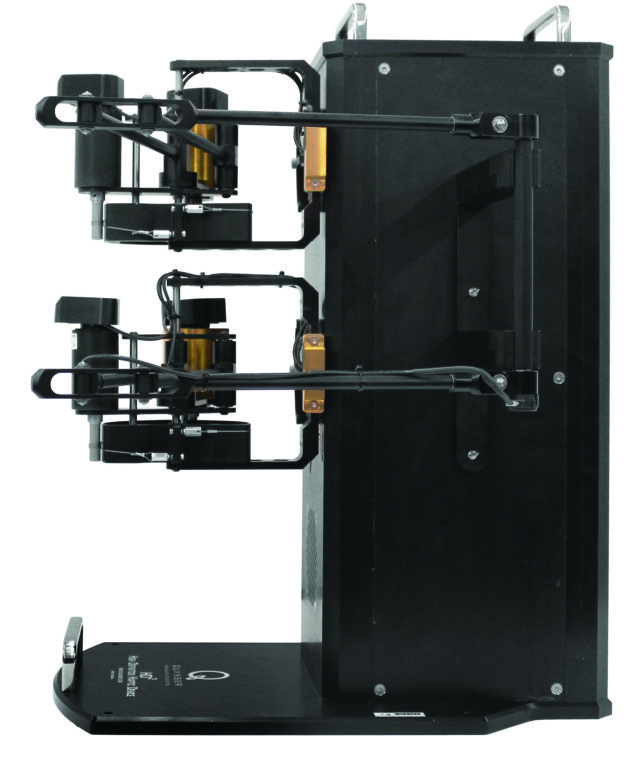 Haptic interaction · teleoperation
HD² Haptic Device →
Explore human motion, programmable feedback, and teleoperation.
Photograph: Quanser
Planned QArm + HD² teleoperation
A supervised experiment connecting human input, robot motion, and carefully bounded haptic feedback.
Operator → mapping → QArm
Handle motion can define a scaled robot reference. Robot state and the selected interaction model can inform feedback to the operator. Identify whether feedback is measured, estimated, or virtual; motor current alone is not a calibrated contact-force measurement.
Begin in a virtual environment. Verify coordinate frames, joint limits, collision boundaries, delay, and stop behavior before physical interaction.
Bring this unit into your course or project
Faculty and students across Howard’s computing and engineering programs can discuss course, research, VIP, capstone, and senior design activities with AVRC. The instructor and faculty mentor define the learning objectives, experiment, preparation, and assessment.
Bring your course or project to the lab.
Discuss the learning goals, platform, team size, and supervision needed for a practical lab experience.