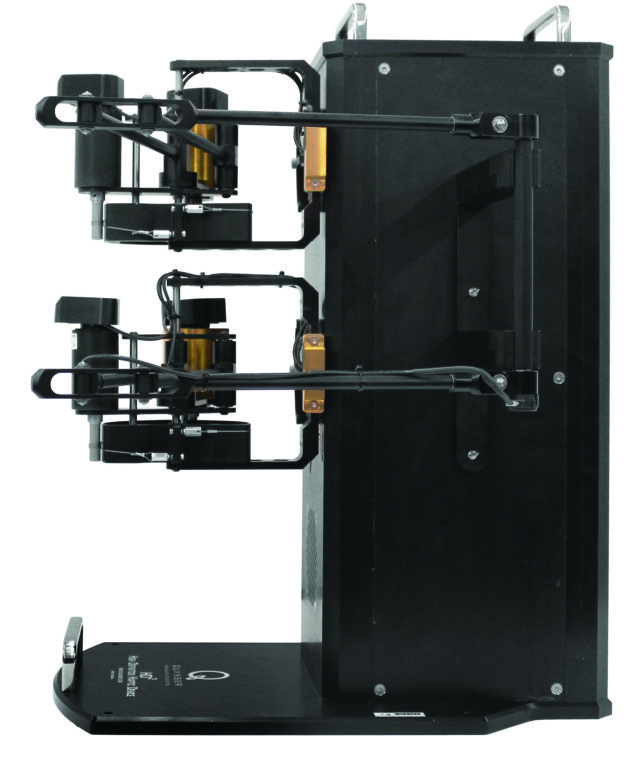
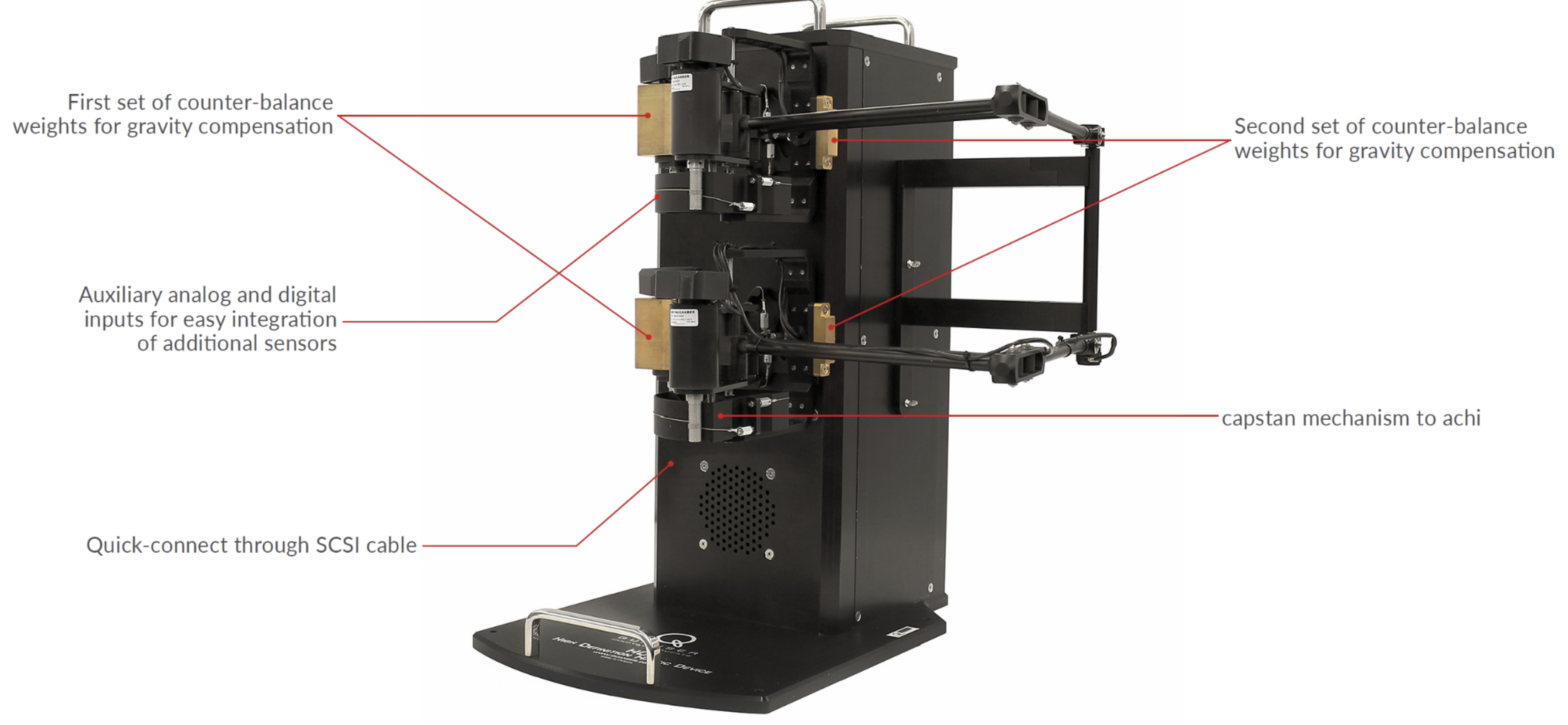
HD² uses a backdrivable parallel mechanism and capstan drives to provide programmable haptic interaction. Optical encoders measure motion, and built-in linear current amplifiers drive the motors. An external data acquisition interface connects it to the control computer.
Inputs & outputs
Measured handle motion enters the teleoperation controller; bounded feedback commands return to the haptic device. QArm motion and gripper commands form a separate control path.
Suggested AVRC learning activities. Use the linked manufacturer procedure and the instructor’s approved setup for the actual experiment.
A practical learning sequence
Complete haptic-device training and identify the emergency stop, workspace, and force limits.
Begin with a supervised virtual environment and low-force interaction.
For the planned QArm study, establish scaling, coordinate mapping, and communication-loss behavior before connecting the physical arm.
Teaching, outreach & research
Teaching: impedance, interaction forces, and human-in-the-loop control.
Outreach: demonstrate a virtual surface or guided motion under supervision.
Planned research: QArm teleoperation; feedback may be model-based or sensor-derived and must be identified explicitly.
Go directly to the source
Official manuals and resources may have their own licensing or sign-in requirements. Use material for the exact platform generation and software release.