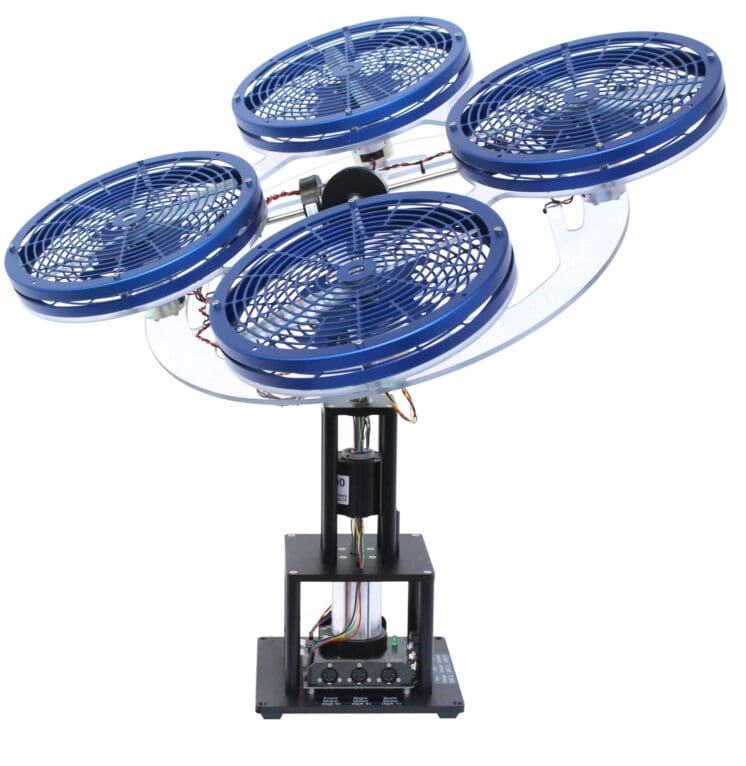
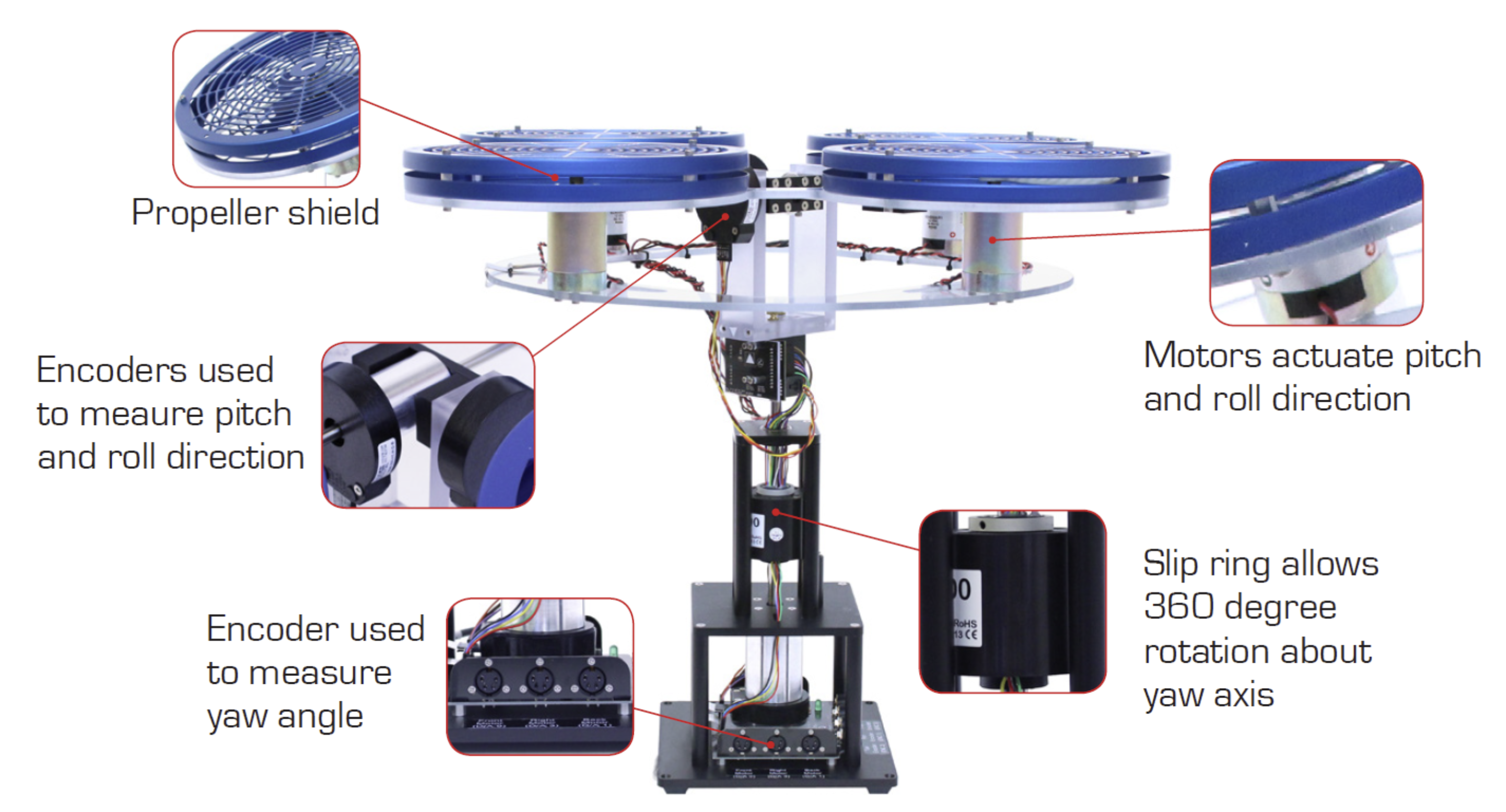
Four DC motors drive propellers on a frame supported by a three-axis pivot. Differential thrust and reaction torque control roll, pitch, and yaw. This is an attitude-control rig: it rotates about its support and does not perform free-flight translation.
Inputs & outputs
Four motor-voltage inputs and three measured orientation outputs. A control-allocation step maps requested body torques to motor commands.
Suggested AVRC learning activities. Use the linked manufacturer procedure and the instructor’s approved setup for the actual experiment.
A practical learning sequence
Identify the external DAQ, amplifier channels, encoder channels, and approved wiring from the workstation manual.
Establish the angle conventions and use the supplied initialization procedure.
Compare an approved attitude controller with a baseline; report response, coupling, and actuator limits.
Teaching, outreach & research
Teaching: rigid-body attitude, control allocation, and MIMO feedback.
Outreach: relate balanced rotor forces to orientation.
Research question: how can an attitude controller tolerate disturbances or actuator mismatch?
Go directly to the source
Official manuals and resources may have their own licensing or sign-in requirements. Use material for the exact platform generation and software release.